
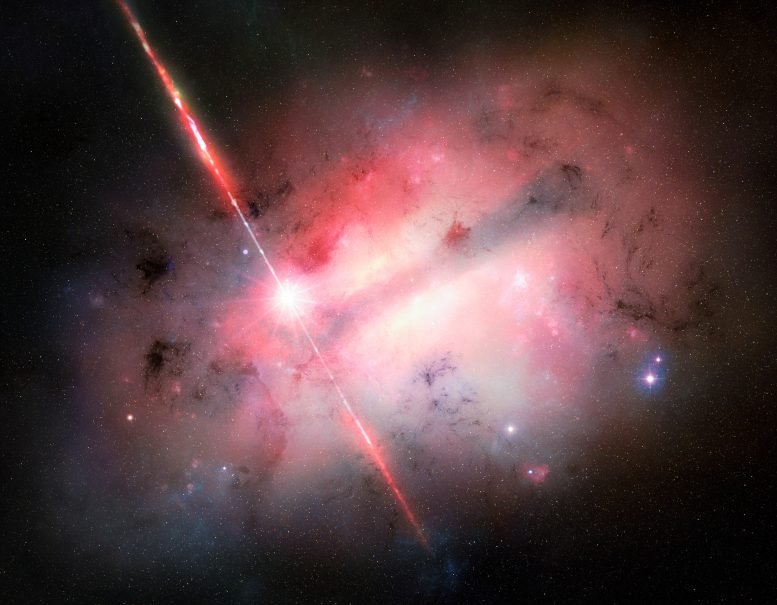
Gamma-ray bursts, often called GRBs, are sudden flashes of intense gamma radiation coming from deep space. They are the brightest electromagnetic events known in the universe today. Scientists first detected these mysterious signals in the late 1960s. At that time, satellites designed to monitor nuclear tests noticed unexplained gamma flashes. Over time, astronomers confirmed that these bursts came from far beyond Earth. Since then, GRBs have become a major focus in space science. They help researchers study extreme physics and cosmic evolution. Importantly, these bursts occur without warning. Their energy output can briefly exceed that of entire galaxies. Therefore, GRBs offer a rare look into violent cosmic events.
Gamma rays are the highest-energy form of light. They carry far more energy than visible light or X-rays. When a gamma-ray burst happens, it releases huge energy in seconds. Some bursts last only milliseconds. Others continue for several minutes. However, even the shortest bursts can release massive power. Scientists measure this energy using space-based telescopes. Earth’s atmosphere blocks gamma rays. Therefore, satellites are essential for detection. As a result, space agencies across the world actively monitor the sky. These missions include NASA, ESA, and other partners.
Astronomers divide gamma-ray bursts into two main types. This classification depends on duration and origin. Short GRBs last less than two seconds. Long GRBs last more than two seconds. However, the difference goes beyond timing. Long bursts usually come from massive star collapse. Short bursts likely come from merging neutron stars. Each type reveals different cosmic processes. Therefore, GRBs help scientists understand stellar life cycles.
Long gamma-ray bursts occur when very large stars die. These stars are many times heavier than the Sun. When they run out of fuel, their cores collapse. This collapse forms a black hole or neutron star. As the star collapses, narrow jets shoot out at near light speed. These jets release gamma radiation. When one jet points toward Earth, detectors record a burst. Meanwhile, the rest of the star explodes as a supernova. This link between GRBs and supernovae was confirmed in the early 2000s. Since then, researchers have studied many such events.
Short gamma-ray bursts have a different origin. They are believed to form when two neutron stars collide. Sometimes a neutron star merges with a black hole. These objects are extremely dense. A teaspoon of neutron star material weighs billions of tons. When they collide, enormous energy is released. This creates a brief gamma-ray flash. These events also produce gravitational waves. In 2017, scientists detected both gamma rays and gravitational waves from the same event. This discovery marked a major breakthrough. It confirmed long-standing theories about short GRBs.
Gamma-ray bursts are detected using specialized satellites. NASA’s Swift Observatory is one of the most important tools. It can quickly turn toward a burst location. This allows scientists to study the afterglow. Another key mission is the Fermi Gamma-ray Space Telescope. Fermi observes higher-energy gamma rays. Together, these missions provide detailed data. International collaborations also contribute. As a result, GRB detection has become faster and more accurate.
After the initial flash, GRBs often produce an afterglow. This afterglow appears in X-ray, optical, and radio wavelengths. It can last for days or even months. By studying afterglows, scientists measure distance and environment. They also learn how jets interact with space matter. Importantly, afterglows help identify host galaxies. This gives clues about star formation in early cosmic history. Therefore, GRBs are valuable tools for cosmology.
Many gamma-ray bursts come from extremely distant galaxies. Some occurred billions of years ago. This means scientists see them as they were long ago. In fact, GRBs act as cosmic time machines. They help researchers study the early universe. Some bursts formed when the universe was very young. At that time, stars were forming rapidly. By observing GRBs, astronomers learn how early stars lived and died.
Gamma-ray bursts also test the laws of physics. The conditions during these explosions cannot be recreated on Earth. Temperatures and energies are extremely high. Particles move close to light speed. Therefore, GRBs help scientists study relativity and particle physics. They also help explore magnetic fields under extreme pressure. These studies improve theoretical models. Over time, this knowledge benefits many areas of astrophysics.
Despite their power, gamma-ray bursts do not threaten Earth directly. Most GRBs occur far away. Their narrow jets also limit exposure. Scientists believe a nearby direct hit would be dangerous. However, such an event is extremely unlikely. No known nearby stars pose this risk. Therefore, GRBs remain a subject of study, not fear.
Public interest in gamma-ray bursts has grown in recent years. Improved telescopes and faster alerts have helped. News of major detections often spreads quickly. Social media and science portals share discoveries widely. In India, space enthusiasts follow these updates closely. Institutions like ISRO also monitor high-energy space events. Regional universities increasingly participate in astrophysics research. This reflects a growing interest in space science across the country.
Gamma-ray burst research also benefits future missions. New satellites are being planned. These missions will detect fainter and faster bursts. They will also cover wider areas of the sky. Artificial intelligence helps analyze data quickly. This reduces response time for telescopes on Earth. As a result, more afterglows can be observed. This improves data quality and discovery rates.
GRBs also connect with multi-messenger astronomy. This field combines light, gravitational waves, and particles. The 2017 neutron star merger proved its importance. Since then, scientists aim to detect more combined events. These observations give a complete picture of cosmic explosions. Therefore, GRBs play a central role in modern astronomy.
Researchers continue to ask important questions. Why do some bursts release more energy than others. How exactly do jets form and stay focused. What role do magnetic fields play. Scientists also study why some GRBs lack visible supernova signs. Each answer leads to new questions. This ongoing research keeps the field active.
In the Indian context, astronomy education is expanding. More students are choosing astrophysics careers. Online access to global data helps learning. GRB alerts are publicly available. Amateur astronomers also try to observe afterglows. This creates a bridge between professionals and enthusiasts. It also strengthens scientific culture regionally.
Gamma-ray bursts remain among the most exciting cosmic events. They combine mystery, power, and discovery. Each detection adds to human understanding of the universe. While much has been learned, many secrets remain. Therefore, GRBs will continue to headline space research. They remind us how dynamic and violent the universe can be. At the same time, they show how far science has come.

Abhijeet is a software engineer who moonlights as a tech writer. His love for gadgets, mobile innovations, and smart devices keeps him closely connected to India’s fast-growing tech scene. When he’s not coding, he’s usually testing the latest earbuds or Android updates.