
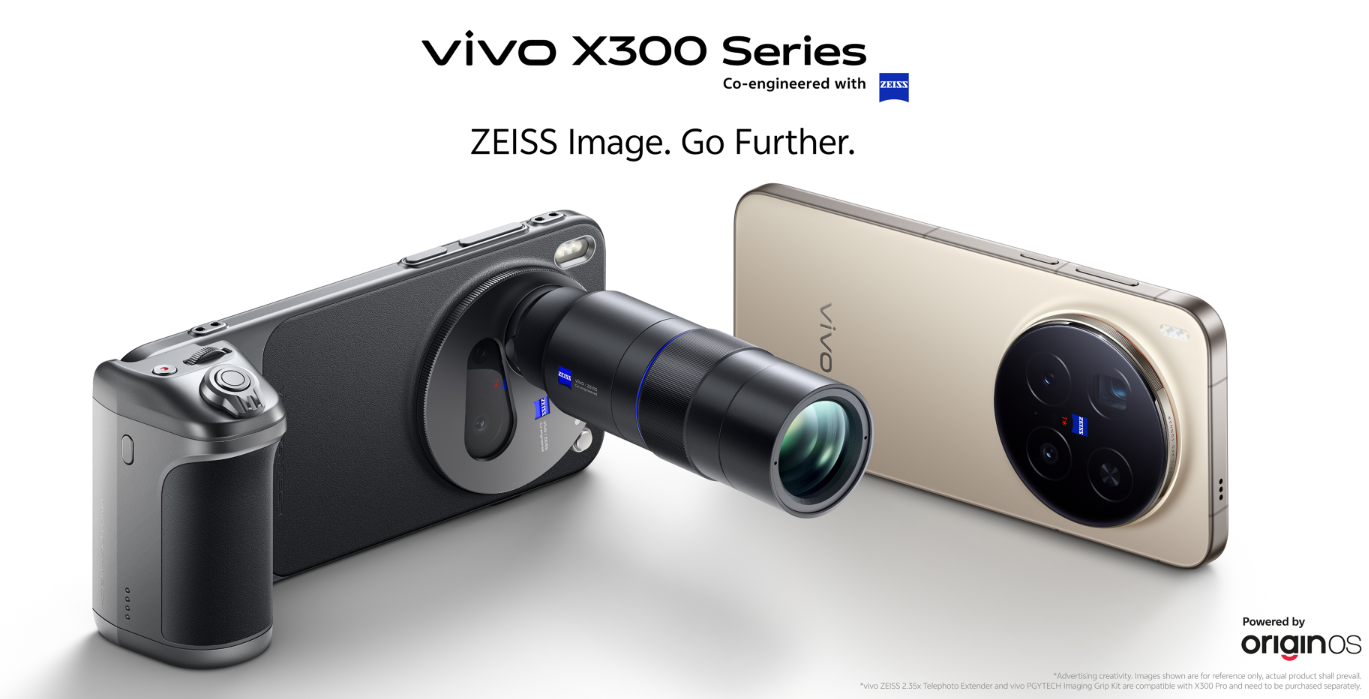
Vivo is all set to introduce a big flagship in India this December with the launch of Vivo X300 and Vivo X300 Pro. The series, which only recently arrived in China, represents Vivo’s biggest leap yet in terms of mobile imaging, performance, and battery technology, and India will get both models next month.
The lineup continues the strong focus on computational photography, premium design, and long-term software support with Android 16 out of the box and five major OS updates guaranteed.
The Vivo X300 is aimed at users who need a compact flagship with a powerful camera system and top-notch performance, while the X300 Pro pushes the limits for imaging, display technology, and battery capacity to cater to power users and creators.
Design and Build:
Both devices share the same design language with glass backs, aluminum alloy frames, and IP68/IP69 certification, making them resistant to dust and high-pressure water jets.
The standard Vivo X300 is more compact, with a height of 150.6 mm and a weight of 190 g, thus becoming one of the more pocket-friendly flagships today.
Meanwhile, the X300 Pro is larger at 6.78 inches and weighs 226 g, adding a more substantial, premium in-hand feel.
The Pro model also upgrades to Armor Glass protection on the front compared to the reinforced glass on the X300.
Display: Bright, Smooth, and HDR-Ready
Both phones feature LTPO AMOLED panels with 1B colors, 120Hz refresh rate, 2160Hz PWM dimming, and peak brightness up to 4500 nits, one of the highest in the industry.
| Feature | Vivo X300 | Vivo X300 Pro |
|---|---|---|
| Size | 6.31″ | 6.78″ |
| Resolution | 1216×2640 | 1260×2800 |
| HDR | HDR10+, HDR Vivid | HDR10+, HDR Vivid, Dolby Vision |
| Protection | Reinforced Glass | Armor Glass |
The Pro edition adds Dolby Vision and slightly higher real-world peak brightness (2113 nits measured).
Performance – Dimensity 9500
Both devices come with the MediaTek Dimensity 9500 (3nm) chipset, one of the most powerful Android chipsets in 2025. Benchmarks demonstrate impressive scores:
X300: Up to 3.41M (AnTuTu v11)
X300 Pro: Up to 3.53M (AnTuTu v11)
Storage on both phones is UFS 4.1, but the Pro model uses a dual-UFS 4.1 architecture for better sustained performance.
Camera Systems:
This generation also continues Vivo’s partnership with ZEISS, bringing improved optics, T* lens coating, and new computational photography tools like 3D LUT import.
Vivo X300 – Camera System
- 200MP main sensor (1/1.4″)
- 50MP periscope telephoto (3x optical)
- 50MP ultrawide (119°)
- 4K at up to 120fps HDR
- Selfie: 50MP, 4K60
Vivo X300 Pro – Camera System
- 50MP main sensor (1/1.28″, 1.22µm) — larger than X300’s main sensor
- 200MP periscope telephoto (1/1.4″), 3.7x optical zoom, with macro mode
- 50MP ultrawide (119°)
- Supports 8K@30fps, 10-bit Log video, Dolby Vision HDR recording
- Selfie: 50MP, 4K60
Key Camera Differences:
- X300 Pro gets a larger main sensor and significantly upgraded periscope camera.
- Among all, only Pro supports 8K video, 10-bit Log, Dolby Vision HDR, and advanced zoom capabilities.
- Both phones retain laser AF, ZEISS optics, and strong computational photography features.
Battery & Charging: Large Capacities with Fast Charging
| Feature | Vivo X300 | Vivo X300 Pro |
|---|---|---|
| Capacity | 6040 mAh (Global) | 6510 mAh (Global) |
| Wired Charging | 90W | 90W |
| Wireless | 40W | 40W |
| Reverse | Wired | Wired + Wireless |
The X300 Pro offers a larger battery and adds reverse wireless charging, making it more versatile.
Connectivity and Extras
Both models offer:
- Wi-Fi 7
- Bluetooth 5.4 with aptX HD + LHDC 5
- Full satellite navigation including NavIC: L5
- Infrared blaster
- USB-C 3.2
- Ultrasonic in-display fingerprint sensor
The X300 Pro also supports optional satellite connectivity, if your region allows for it.
Indian pricing is expected to undercut European pricing, with estimates:
X300: ₹89,999 – ₹99,999
X300 Pro: ₹119,999 – ₹129,999
(final pricing TBA at launch)
Key Differences: Vivo X300 vs X300 Pro (Summary)
- Display: Pro is larger and adds Dolby Vision + Armor Glass.
- Camera – Pro gets a larger main sensor, better periscope (3.7x vs 3x), 8K video, 10-bit Log, and Dolby Vision HDR.
- Battery: Pro has bigger battery and reverse wireless charging.
- Build: Pro uses Armor Glass and is heavier. Performance: Slight edge for Pro because of its dual-UFS 4.1 storage. Connectivity: Pro features optional satellite communication.

Prasad aka PD is an automotive enthusiast from Mumbai who splits his time between his corporate sales job and his love for motorcycles. He covers bike launches, engine tech, and the evolving EV space with genuine curiosity and excitement.