
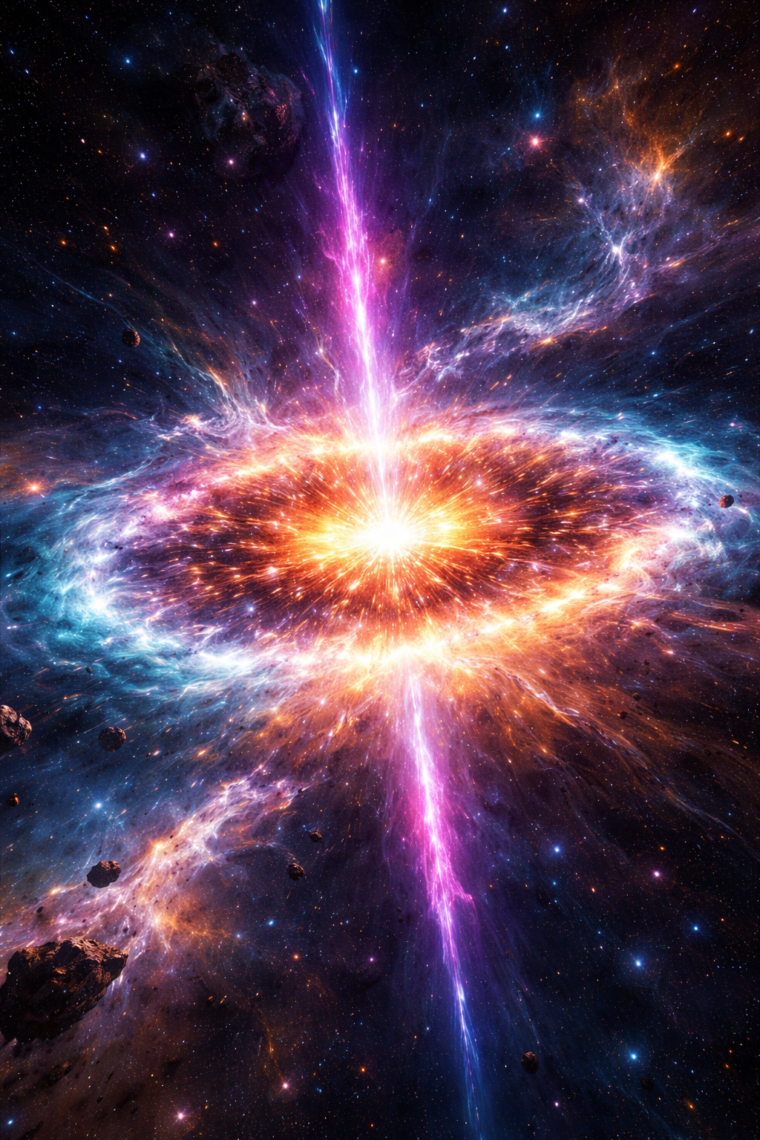
Astronomers are closely studying a powerful cosmic idea called a superkilonova. The term describes a theorized stellar explosion beyond known kilonova events. Scientists believe it could occur during extreme neutron star or black hole mergers. If confirmed, it may reshape understanding of cosmic element creation.
In recent years, space observatories have detected brighter and longer afterglows from stellar collisions. These unusual signals sparked debate among astrophysicists worldwide. Many now question whether some events exceed standard kilonova limits. As a result, the concept of a superkilonova is gaining attention.
A kilonova happens when two neutron stars collide and merge violently. This collision releases intense light, heat, and gravitational waves. It also forges heavy elements like gold and platinum. However, a superkilonova could release far greater energy and matter.
Researchers explain that neutron stars are ultra-dense stellar remnants. They form after massive stars collapse during supernova explosions. When two neutron stars orbit each other, they slowly spiral inward. Eventually, they crash together at incredible speeds.
During a typical kilonova, debris is flung into space at near-light velocity. This debris glows as radioactive elements decay. Telescopes detect this glow across optical and infrared wavelengths. The brightness usually fades within days or weeks.
A superkilonova, however, may behave very differently. Scientists suggest it could shine brighter and last longer. It may eject more material and create heavier elements. Some models predict luminosity rivaling small supernovae.
The idea gained traction after unusual observations from deep-space surveys. Astronomers noticed merger afterglows that defied existing kilonova models. These signals appeared stronger and more complex than expected. Therefore, researchers began testing expanded theories.
One possible trigger for a superkilonova involves unequal neutron star masses. When one star is significantly heavier, the merger becomes chaotic. This imbalance could eject more matter outward. Consequently, the explosion could grow more energetic.
Another proposed cause involves neutron star and black hole mergers. In some cases, the black hole may not immediately swallow the neutron star. Instead, it may tear the star apart first. This violent disruption could power a superkilonova-scale event.
Scientists also examine the role of magnetars in these explosions. A magnetar is a neutron star with an extremely strong magnetic field. If a merger briefly forms a magnetar, it could inject extra energy. This process might intensify the kilonova glow.
Astrophysicists stress that superkilonova remains a theoretical concept. No event has been officially classified under this name yet. Still, multiple research papers discuss its plausibility. The debate continues within the global astronomy community.
Gravitational wave astronomy plays a key role in this research. Since 2015, detectors like LIGO and Virgo have recorded spacetime ripples. These ripples come from massive cosmic collisions. Each detection offers clues about merger strength and structure.
The famous 2017 neutron star merger changed astronomy forever. It confirmed that kilonovae produce heavy elements. It also linked gravitational waves with visible light. Since then, scientists search for even stronger events.
Some newly detected signals appear unusually energetic. Their light curves do not match standard kilonova templates. Moreover, their spectral signatures suggest complex element formation. These anomalies keep the superkilonova idea alive.
Astronomers rely on powerful telescopes for further evidence. Space observatories scan infrared wavelengths for merger afterglows. Ground-based telescopes capture optical data within hours. Together, they build a complete picture of these explosions.
Computer simulations also help test the theory. Researchers simulate extreme merger scenarios using supercomputers. These models predict how matter behaves under intense gravity. Some results support the possibility of superkilonova-like emissions.
Heavy element production lies at the heart of this research. Scientists seek to explain where the universe’s gold originated. Kilonovae already explain much of this mystery. However, superkilonovae could account for rare abundance patterns.
In regional observatories, interest in cosmic explosions is growing steadily. Indian astrophysicists contribute to gravitational wave data analysis. They also support follow-up observations using domestic facilities. This collaboration strengthens global research efforts.
Public interest also rises with each new discovery. Cosmic explosions capture imagination across generations. The idea of gold forming during stellar collisions fascinates many. A superkilonova would add another dramatic chapter.
Despite excitement, scientists urge caution. Extraordinary claims require strong observational proof. The astronomy community avoids premature labels. Therefore, researchers continue to analyze data carefully.
Future detectors will greatly improve detection sensitivity. Planned upgrades aim to spot weaker gravitational signals. This improvement may reveal more extreme mergers. With better data, classification becomes clearer.
The James Webb Space Telescope may also help. Its infrared instruments can observe distant merger afterglows. Such data could confirm unusually powerful kilonova events. Consequently, the superkilonova theory may soon face testing.
Researchers also look beyond brightness alone. They examine element signatures and decay rates. These details reveal explosion mechanics. Differences from known kilonovae would be significant.
Astrophysics thrives on careful naming and classification. Terms like supernova evolved over decades. Similarly, superkilonova may require years of study. Only consistent evidence will justify the label.
For now, the term acts as a working hypothesis. It helps scientists discuss extreme outcomes of stellar mergers. It encourages deeper analysis and broader simulations. This process advances the field steadily.
The discovery of a true superkilonova would mark a milestone. It would expand the cosmic explosion family. It could refine theories of matter, gravity, and energy. Such progress shapes modern astronomy.
As sky surveys grow more advanced, surprises are expected. The universe often reveals more than predicted. Each unexpected signal pushes science forward. Superkilonova may be the next revelation.
In summary, a superkilonova represents a possible extreme stellar explosion. It builds on known kilonova physics. While unconfirmed, evidence continues to accumulate. Astronomers remain alert for the decisive signal.

Siddharth is a Kochi-based mechanical engineer with a lifelong fascination for cars. His weekend passion involves analyzing new engines, driving technologies, and India’s growing electric car market. He brings technical depth with everyday readability.