
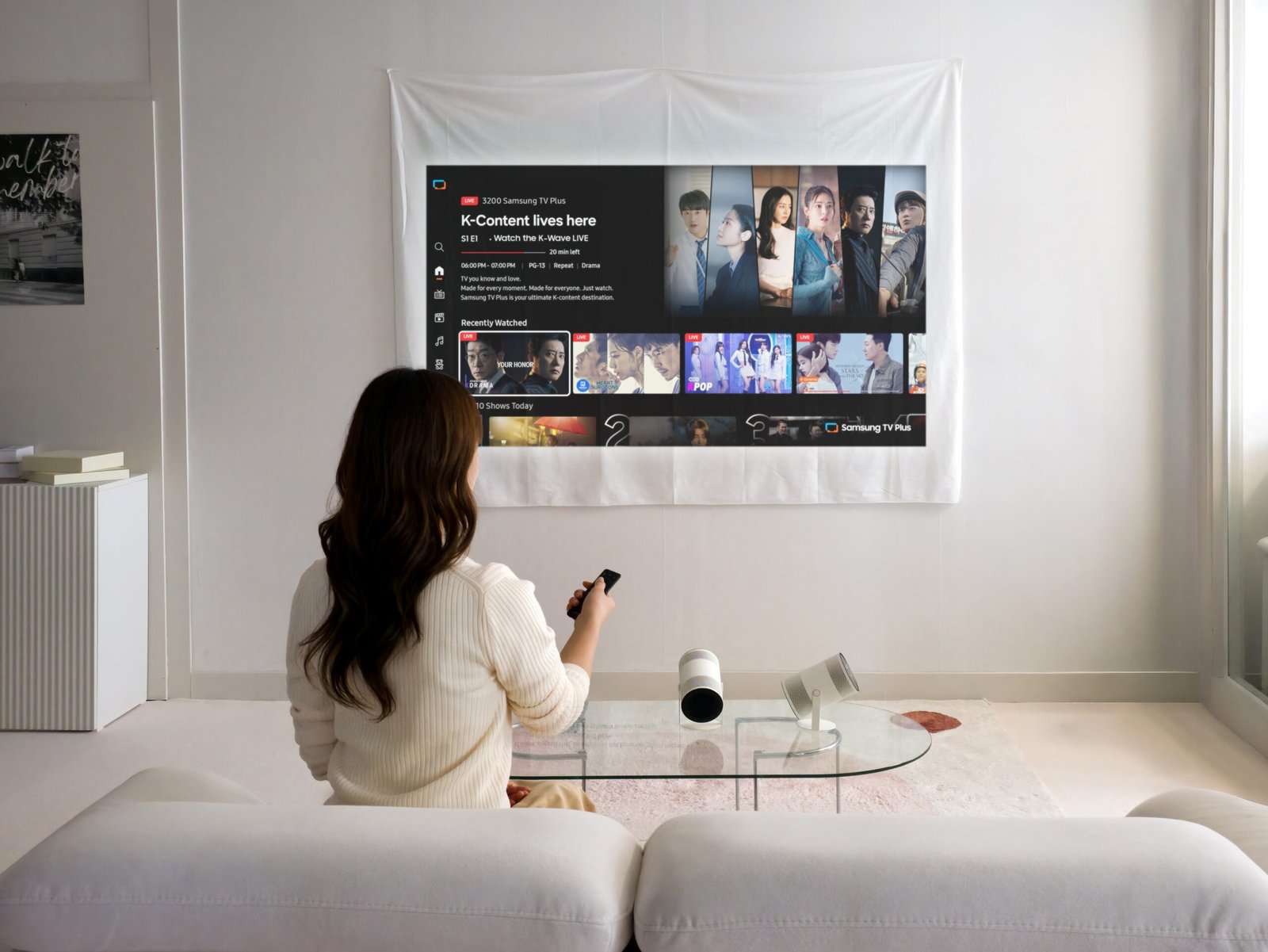
Samsung Electronics has announced the global launch of The Freestyle+, an AI-powered portable projector unveiled ahead of CES 2026 in Las Vegas. The company says the new model builds on the original Freestyle design while delivering stronger brightness, smarter AI optimization and wider entertainment access. As a result, users can stream, play games and watch content across different spaces with minimal setup. Moreover, Samsung positions the Freestyle+ as a lifestyle screen for homes, trips and everyday moments. The projector introduces AI OptiScreen technology, a brighter 430 ISO Lumens output and built-in access to Samsung TV Plus and gaming services. With a phased rollout planned in early 2026, Samsung aims to strengthen its presence in the growing portable display market.
Samsung’s latest announcement comes at a time when demand for flexible home entertainment continues to rise across regions. In India and other emerging markets, compact screens increasingly replace fixed televisions in smaller homes. Therefore, Samsung’s focus on portability and smart automation appears timely. The Freestyle+ is designed to work across living rooms, bedrooms, hostels and even outdoor settings. Instead of complex installation, the device promotes a point-and-play approach. This philosophy reflects a wider industry shift toward screens that adapt to people, rather than spaces adapting to screens.
According to Samsung, the Freestyle+ introduces AI OptiScreen as its core upgrade. This system automatically adjusts visuals based on the projection surface and surrounding environment. As a result, users no longer need to manually correct distortion or focus. AI OptiScreen supports real-time focus adjustment, which keeps the image sharp during movement. Additionally, 3D Auto Keystone corrects distortion on uneven or angled surfaces. This feature becomes useful in homes where flat white walls are not always available.
Moreover, Wall Calibration technology analyzes surface colour and texture. Consequently, it reduces colour distortion caused by patterned walls or curtains. Samsung also adds Screen Fit support for compatible screen accessories. This helps align images accurately without user intervention. Together, these features aim to simplify setup for first-time users. Industry observers often ask whether portable projectors compromise quality for convenience. Samsung’s answer here appears to be intelligent automation rather than manual controls.
The Freestyle+ also integrates Vision AI Companion, Samsung’s personalized AI platform for screens. This system combines an enhanced Bixby assistant with AI services from global partners. As a result, users can interact with content through more natural voice commands. For example, viewers can ask for recommendations or control playback conversationally. While Samsung has not disclosed partner names in detail, the company highlights smoother interaction as a key benefit. This aligns with broader consumer interest in hands-free control across smart devices.
From a design perspective, the Freestyle+ retains a compact cylindrical shape. This familiar design allows easy movement between rooms. Furthermore, the device supports a 180-degree rotating projection. This enables projection onto walls, ceilings or floors without mounts. In many Indian homes, flexible placement becomes essential due to space constraints. Therefore, Samsung’s rotating design addresses a practical regional need.
Brightness sees a significant improvement over the previous generation. The Freestyle+ delivers 430 ISO Lumens, nearly double the earlier model. Consequently, images appear clearer in everyday lighting conditions. While portable projectors often struggle in bright rooms, Samsung claims this upgrade improves usability during daytime viewing. Consumers often ask how portable projectors perform without dark rooms. The Freestyle+ attempts to bridge that gap through brightness and AI optimization.
Entertainment access forms another major highlight. The Freestyle+ offers built-in access to Samsung TV Plus and certified OTT partners. This means users can stream content without external devices. Additionally, Samsung Gaming Hub support allows cloud gaming directly from the projector. For younger users and casual gamers, this reduces the need for consoles. In regions with increasing cloud gaming adoption, this feature may attract attention.
Audio performance also receives a notable boost. The Freestyle+ includes a built-in 360-degree speaker. Samsung states the speaker delivers richer, room-filling sound despite the compact size. Furthermore, Q-Symphony compatibility allows synchronization with Samsung soundbars. This creates layered audio output when used together. Many consumers ask whether portable projectors can replace TVs completely. Improved sound quality brings the Freestyle+ closer to that goal.
Samsung positions the Freestyle+ as an on-the-go entertainment companion. Unlike traditional projectors, it does not rely on fixed installations. Users can carry it to different rooms or outdoor gatherings. This suits regional lifestyles where family events and shared viewing remain common. Additionally, the compact build supports travel use, including short trips or work presentations.
During the announcement, Hun Lee, Executive Vice President of Samsung’s Visual Display Business, highlighted adaptability as a core vision. He stated that the Freestyle+ adapts naturally to how people live and move. This messaging reflects Samsung’s broader strategy across televisions and monitors. Instead of pushing higher specifications alone, the company emphasizes contextual intelligence.
The Freestyle+ will be showcased at CES 2026 from January 6 to 9 in Las Vegas. CES remains a major platform for consumer electronics launches. By unveiling ahead of the event, Samsung secures early attention. Industry analysts often monitor CES announcements to assess technology trends for the year. In this context, AI-driven display optimization appears to be a growing theme.
Samsung has announced a phased global rollout during the first half of 2026. However, pricing details have not been disclosed yet. Consumers frequently ask about affordability, especially in price-sensitive markets like India. Samsung traditionally positions Freestyle products as premium lifestyle devices. Therefore, pricing will play a crucial role in adoption.
The portable projector market has grown steadily over recent years. Increased streaming usage and remote work have influenced this trend. Additionally, smaller urban homes favour compact devices. Competitors like Anker and Xiaomi have also expanded offerings. However, Samsung’s brand strength and ecosystem integration may provide an advantage.
Another common question relates to durability and daily use. Samsung has not detailed battery specifications in this announcement. Previous Freestyle models relied on external power or optional battery accessories. Therefore, users may await further details during CES demonstrations. Battery performance often determines outdoor usability.
From a newsroom perspective, the Freestyle+ launch fits into Samsung’s wider AI narrative. The company has invested heavily in Vision AI across televisions. By extending this approach to portable screens, Samsung strengthens its ecosystem story. For Google News clustering, this announcement connects with CES 2026 coverage, AI consumer electronics and portable display trends.
The regional impact could be notable. In India, demand for multipurpose devices continues to rise. Students, renters and small families seek flexible entertainment solutions. A projector that adjusts automatically reduces technical barriers. Therefore, the Freestyle+ may appeal beyond tech enthusiasts.
Samsung’s emphasis on minimal setup also reflects changing user expectations. Consumers increasingly prefer devices that work instantly. Long calibration processes discourage adoption. AI OptiScreen directly addresses this friction point. As competition intensifies, such usability improvements become differentiators.
Looking ahead, questions remain about long-term software support. Samsung promises integration with global AI partners. Continuous updates will determine the platform’s relevance. Consumers often ask how often AI features improve after purchase. Samsung’s track record with TVs suggests ongoing updates.
Overall, the Freestyle+ represents an incremental yet meaningful upgrade. It does not reinvent projection technology. Instead, it refines portability, intelligence and accessibility. This approach aligns with Samsung’s mainstream strategy. By focusing on real-world usage, the company targets broader adoption.
As CES 2026 approaches, the Freestyle+ will compete for attention among numerous launches. However, its combination of AI automation, brighter output and ecosystem integration positions it strongly. For users seeking flexible screens without complexity, Samsung’s latest offering may stand out.

Abhijeet is a software engineer who moonlights as a tech writer. His love for gadgets, mobile innovations, and smart devices keeps him closely connected to India’s fast-growing tech scene. When he’s not coding, he’s usually testing the latest earbuds or Android updates.