
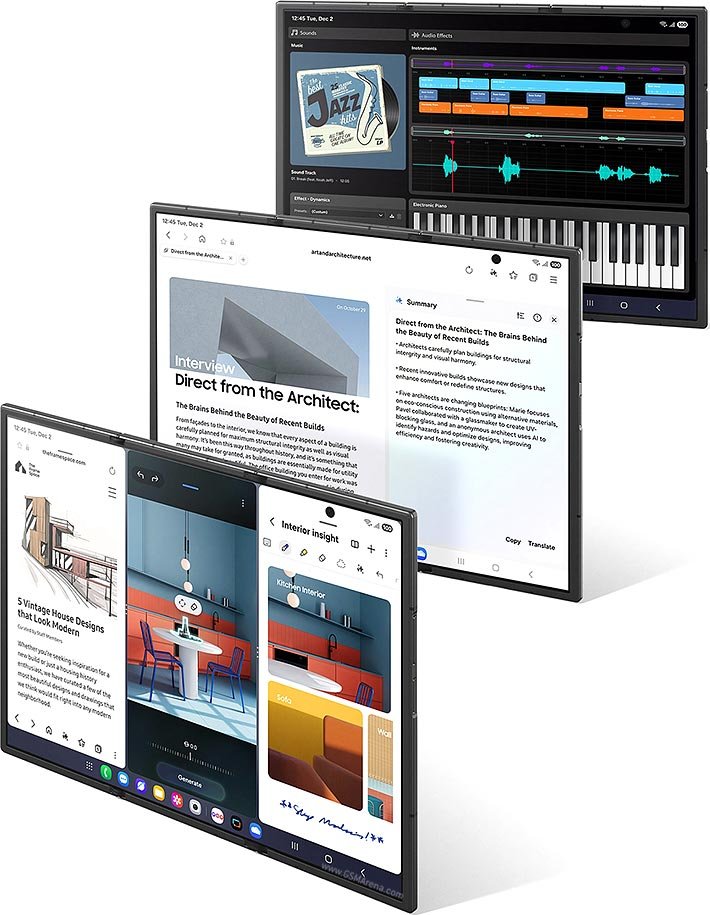
Samsung has officially introduced the Galaxy Z TriFold, one of the most ambitious smartphone designs the company has ever created. The device will go on sale in South Korea starting December 12, marking the first commercial arrival of a tri-folding phone. Samsung positions the Galaxy Z TriFold as the next step in the evolution of mobile screens, offering a tablet-sized display in a compact form that still fits in a pocket.
Samsung’s new foldable opens into a large 10-inch Dynamic LTPO AMOLED 2X display. Users get a near-square 4:3 aspect ratio with a screen that reaches 1600 nits peak brightness and supports a smooth 120Hz refresh rate. When folded, the device turns into a regular smartphone with a 6.5-inch AMOLED 2X cover screen protected by Corning Gorilla Glass Ceramic 2. This outer display also runs at 120Hz and can reach up to 2600 nits, making it easier to use outdoors.
The company built the Galaxy Z TriFold with a focus on durability. The frame uses Samsung’s Advanced Armor aluminum, while the hinge housing is reinforced with titanium. The device carries an IP48 rating, allowing it to resist dust particles larger than 1mm and survive underwater up to 1.5 meters for 30 minutes. Despite its large form factor, Samsung keeps the weight at 309 grams, which is heavy for a phone but acceptable for a device that transforms into a tablet.
Samsung packs the phone with top-tier hardware. It runs Android 16 with One UI 8 and uses Qualcomm’s Snapdragon 8 Elite chipset built on a 3nm process. The octa-core CPU features the company’s powerful Oryon V2 architecture, while the Adreno 830 GPU handles graphics-intensive tasks at high performance levels. The phone comes in two storage variants, 512GB with 16GB RAM and 1TB with 16GB RAM. Samsung uses UFS storage for fast app launches and quick file access.
The Galaxy Z TriFold carries a strong camera system that includes a 200-megapixel main sensor with optical image stabilization, a 10-megapixel telephoto lens with 3x optical zoom, and a 12-megapixel ultrawide camera. The rear cameras support 8K recording at 30fps and 4K at 60fps, along with 10-bit HDR and HDR10+. Samsung also includes two selfie cameras—one inside the main folding display and another on the cover display—both carrying 10-megapixel sensors capable of shooting 4K video.
The device supports modern connectivity features such as Wi-Fi 7, Bluetooth 5.4 with aptX HD, NFC, GPS, and multi-band positioning systems. Samsung continues to skip the 3.5mm headphone jack but provides stereo speakers for a better media experience. The side-mounted fingerprint scanner takes care of security.
Battery performance gets a boost with a 5600mAh unit. Samsung supports 45W wired charging that can reach 50 percent in about 30 minutes, along with 15W wireless charging and 4.5W reverse wireless charging. The large battery should help handle the power demands of the tri-folding display.
Samsung also includes wireless DeX, allowing users to turn the Galaxy Z TriFold into a desktop-like computing setup. Combined with the massive unfolded display, the phone clearly targets users who want productivity and portability in one device.
The arrival of the Galaxy Z TriFold signals a major shift in Samsung’s foldable strategy. Instead of refining the two-panel design, the company has stepped into a new category that blends smartphone, tablet, and compact computer into a single product. With its launch set for December 12 in South Korea, global markets are expected to follow soon. If successful, the Galaxy Z TriFold could open a new chapter in how consumers use mobile devices and push the foldable industry toward more experimental designs.

Shruti is a content strategist from Chennai with a strong interest in mobility tech and smart devices. She contributes part-time stories on new smartphone launches, EV trends, and India’s growing digital lifestyle.