
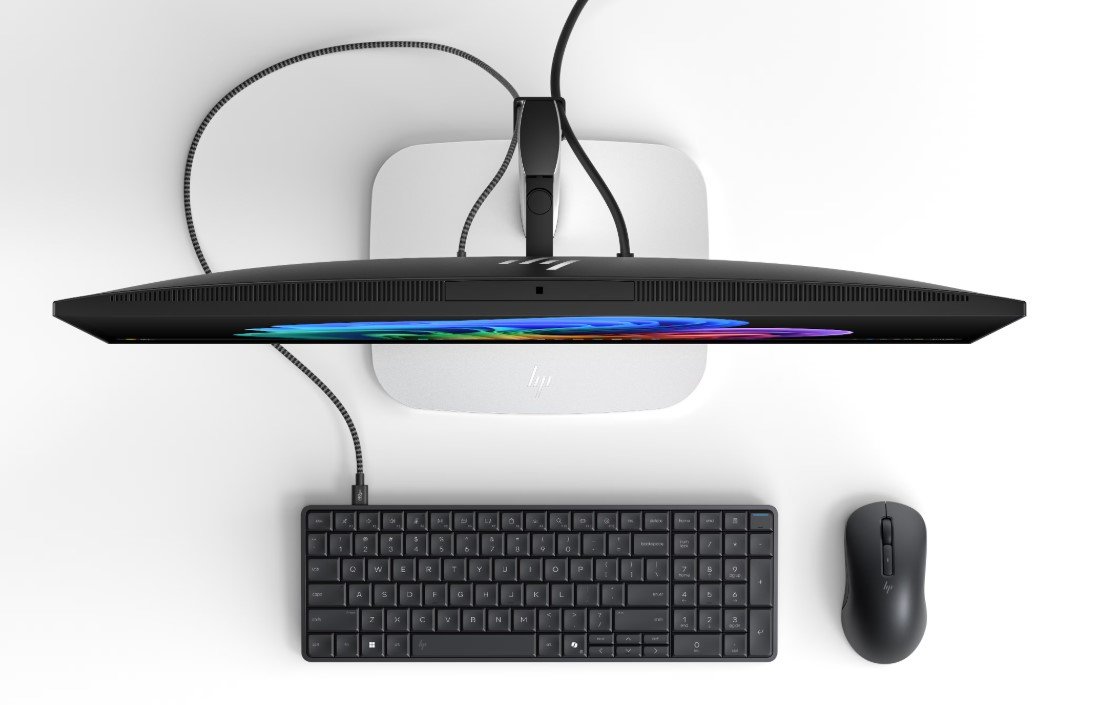
HP Inc today unveiled the HP EliteBoard G1a Next Gen AI PC at CES 2026. The device earned a CES 2026 Innovation Award Honoree recognition. It becomes the world’s first full AI PC built directly into a keyboard. The launch reflects a wider shift in how offices operate across regions. HP also introduced the new HP Series 7 Pro 4K Monitor alongside the keyboard PC. Together, both products target professionals seeking flexible, clutter-free workspaces.
The first announcement comes at a time when work patterns continue to change rapidly. Hybrid offices, shared desks, and mobile teams now define daily routines. HP says traditional desktops no longer fit these evolving needs. The company positions the EliteBoard G1a as a response to this reality. It aims to deliver desktop-class performance without fixed desks.
Guayente Sanmartin, Senior Vice President and Division President at HP Inc, addressed this shift clearly. She said work is being redesigned in real time across industries. She added that employees now expect tools that adapt quickly. According to HP, emerging AI must reduce friction, not add complexity. The EliteBoard G1a, she said, turns local AI into a real productivity advantage.
The design of the EliteBoard challenges long-held desktop norms. Instead of a tower or compact box, computing power sits inside a keyboard. This approach frees desk space immediately. It also allows professionals to carry their core system easily. The keyboard connects to almost any display size. As a result, users can move between offices, homes, or meeting rooms without setup delays.
HP highlights that its 2025 Work Relationship Index influenced the product vision. The study shows only 44 percent of workers feel their technology matches their work style. This gap continues to widen as expectations rise. Employees now demand speed, personalization, and mobility. The EliteBoard attempts to address these demands in a single form factor.
The keyboard measures just 12 millimeters in thickness. It weighs about 750 grams, which is lighter than most laptops. HP says this weight equals less than half of a typical notebook PC. Despite the size, the device includes dual microphones and speakers. This supports video meetings without external accessories. As a result, desks remain clean and organized.
Performance remains central to the EliteBoard story. HP confirms the device uses AMD Ryzen AI 300 Series processors. These chips deliver more than 50 TOPS of NPU performance. This capability supports next-generation AI workloads locally. Tasks like real-time transcription, image enhancement, and predictive workflows benefit directly. Local processing also reduces cloud dependency and latency.
Industry analysts note that local AI processing is gaining attention globally. Internet connectivity varies across regions, including parts of India and Southeast Asia. Devices that process AI locally offer reliability advantages. HP appears to recognize this need clearly. The EliteBoard aligns with broader trends seen at CES 2026.
HP positions the EliteBoard as a Copilot+ PC. This enables deep integration with Microsoft’s AI features. Users can expect smoother AI-assisted workflows. Everyday tasks like document summarization and contextual search become faster. HP says the experience remains lag-free even under heavy workloads.
Thermal and power management also receive attention. HP integrates Smart Sense technology within the device. AMD’s Auto State Management further adjusts performance dynamically. These systems balance speed, cooling, and energy use. Users benefit from consistent performance without excessive heat. An optional built-in battery supports brief unplugged sessions.
Security remains a critical focus for enterprise buyers. HP includes Wolf Security for Business with the EliteBoard. This system offers hardware-enforced protection against firmware attacks. HP also references protection against future quantum threats. Endpoint security covers both hardware and software layers. A tethered lockable cable adds physical protection in shared spaces.
The EliteBoard also carries EPEAT 2.0 Gold registration. This highlights HP’s sustainability goals. Energy efficiency and responsible materials remain part of the design narrative. Sustainability increasingly influences procurement decisions in government and enterprise sectors. HP aligns the product with these priorities.
Alongside the keyboard PC, HP introduced the Series 7 Pro 4K Monitor. This display targets demanding professional users. HP promises high visual fidelity and flawless performance. The monitor supports workflows like design, data analysis, and content creation. When paired with the EliteBoard, it creates a powerful yet minimal setup.
Display quality continues to matter as workloads become more visual. Remote collaboration, data dashboards, and AI-assisted design rely on sharp visuals. HP positions the new monitor as a solution for these needs. The company emphasizes color accuracy and clarity.
CES 2026 showcases many AI-focused devices. However, few challenge form factors as boldly as the EliteBoard. Industry observers note that HP’s approach may influence future desktop designs. Compact computing solutions reduce infrastructure costs. They also simplify IT management across distributed teams.
Regional markets may find the EliteBoard especially relevant. In India, flexible offices and co-working spaces continue to grow. Professionals often switch between locations during the week. A portable desktop keyboard fits these habits well. It reduces dependency on personal laptops for heavy workloads.
HP’s messaging focuses on personalization. Users can shape their workspace anywhere. A single keyboard becomes the core computing unit. Displays, power, and accessories adapt around it. This concept reflects modern work culture across urban centers.
The EliteBoard also supports enterprise deployment models. IT teams can standardize hardware without fixing desks permanently. Devices can move with employees easily. This flexibility supports hot-desking strategies. HP believes this reduces friction and improves productivity.
Market competition in AI PCs continues to intensify. Several vendors showcased AI laptops and mini PCs at CES 2026. HP’s keyboard-based approach stands apart. It targets professionals who value typing comfort and workspace freedom. Best-in-class typing remains a selling point.
HP did not disclose regional pricing during the announcement. Availability timelines may vary by market. Industry sources expect enterprise rollouts first. Consumer availability may follow later. HP traditionally focuses on business buyers for Elite-branded products.
Experts say the EliteBoard reflects a broader design philosophy shift. Hardware now adapts to human behavior, not the reverse. Devices must move, connect, and adjust seamlessly. HP’s launch reinforces this direction.
The new Series 7 Pro 4K Monitor supports this vision further. Visual quality complements compact computing. Together, both products redefine desk essentials. HP frames this as an evolution rather than a replacement.
As AI becomes embedded into daily workflows, form factor innovation gains importance. HP’s EliteBoard G1a attempts to set a new benchmark. The keyboard PC merges performance, portability, and security. Its success may influence future workspace designs.
CES 2026 continues to highlight how AI reshapes hardware. HP’s announcements underline practical applications over experimentation. The company focuses on real work scenarios. This approach aligns with enterprise expectations globally.
With the EliteBoard G1a, HP positions itself strongly in the next phase of AI PCs. The product reflects changing work cultures across regions. Compact power and flexible design now define modern productivity tools.

Abhijeet is a software engineer who moonlights as a tech writer. His love for gadgets, mobile innovations, and smart devices keeps him closely connected to India’s fast-growing tech scene. When he’s not coding, he’s usually testing the latest earbuds or Android updates.