
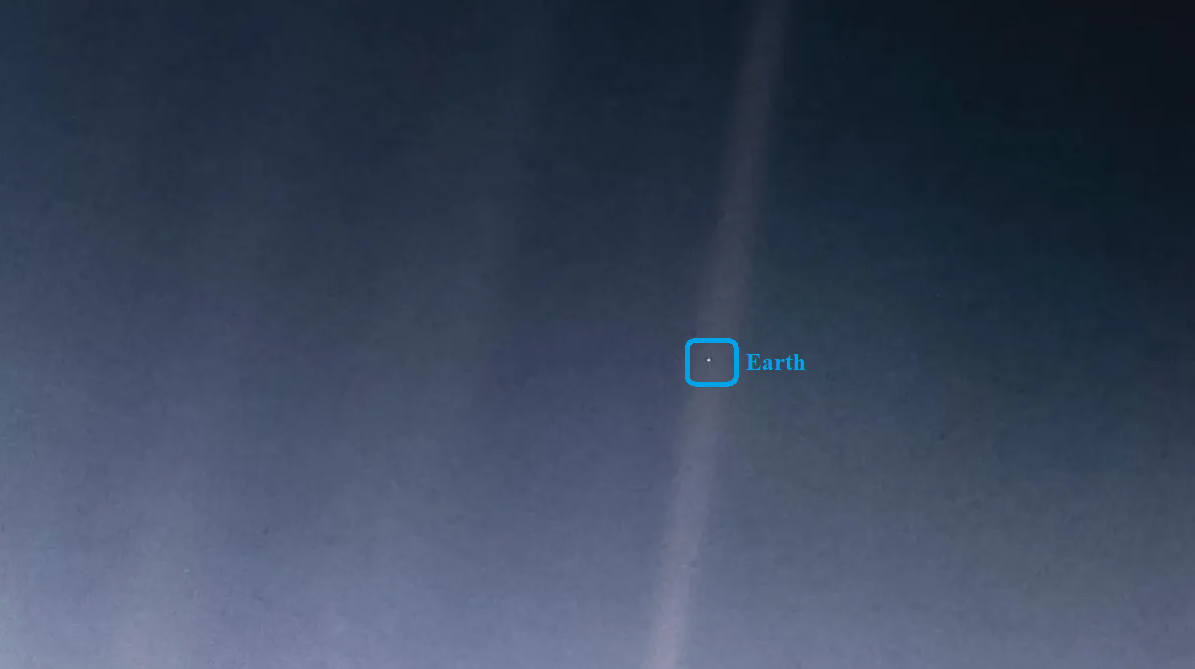
Earth often feels enormous to us. We travel across continents, fly between countries, and even view maps that make our planet feel huge. But once we start to take a few steps back and view Earth from a cosmic perspective, that all changes. Our planet is just a tiny blue dot floating within an enormous solar system, and that solar system is just one piece of a much bigger puzzle. The more we understand about the universe, the clearer it becomes: we are incredibly small, and it is very possible that we are not alone.
The story begins with the Sun, the brilliant star at the centre of our solar system. It is so huge that over 99 percent of the mass of the solar system is taken up just by the Sun. Earth is merely one of eight planets doing an orbit around it. To give you an idea, over one million Earths would fit inside the Sun. The energy that reaches us from the Sun takes eight minutes to cross the 150 million kilometres between us and our star. The planets, which appear near each other in diagrams, are actually separated by unimaginable distances.
The rest of our solar system is beyond Earth. Mars, our nearest potentially habitable neighbor, remains about 54 million kilometers away at its nearest point. Jupiter, the giant of our system, is so large that 1,300 Earths would fit inside it. Then comes Saturn with its famous rings, Uranus and Neptune with their icy atmospheres, and the distant Kuiper Belt, which is the host for dwarf planets such as Pluto. Even if you travel to the edge of the solar system, you still have not reached the true boundary: the Sun’s influence stretches far beyond, into a huge bubble called the heliosphere that shields us from cosmic radiation. This heliosphere extends billions of kilometers, yet it is only a grain of sand inside the Milky Way galaxy.
The Milky Way itself is huge, comprising between 100 billion and 400 billion stars that may have planets of their own. Our entire solar system is situated in one of the galaxy’s outer spiral arms, much like a distant suburb. If the Milky Way were the size of a city, our solar system would be a small house in a quiet suburb. The Milky Way takes approximately 250 million years to complete one full rotation. Humans have only been around for a very small part of this time.
But the scale gets even more unbelievable: the Milky Way is just one galaxy among at least two trillion galaxies in the observable universe. Each of those galaxies contains billions or even trillions of stars. The number of planets in the universe is so large it is almost incomprehensible. Many of these planets orbit stars very much like our Sun, and some of them lie in the region that astronomers call the “habitable zone,” where temperatures permit liquid water to exist on the surface, one of the essential ingredients for life as we know it.
With all the stars, planets, and galaxies, it is increasingly difficult to believe that Earth would be the only place with life. Already, thousands of exoplanets have been discovered by scientists, and some of them seem to be in conditions that can support life. We have also noticed organic molecules floating in the atmospheres of far-away planets and moons, including Saturn’s moon Enceladus and Jupiter’s moon Europa, both of which are thought to have underground oceans. Life on Earth has proved that it can survive in extremes, such as deep-sea vents, frozen deserts, and acidic lakes. If it can thrive in such harsh conditions, it may exist elsewhere.
Even though we don’t have any direct evidence of alien life yet, each year brings us closer to finding some. New telescopes, such as the James Webb Space Telescope, were designed to analyze the atmospheres of distant planets in incredible detail. Scientists are listening for signals, looking for chemical fingerprints, studying worlds both near and far. It’s possible that microbial life could be found right here in our own solar system, or that, one day, we might pick up signs of intelligent life light-years away. Having this sense of the smallness of our universe can sometimes be overwhelming but simultaneously inspiring. It reminds us that Earth is precious, unique, and fragile. All the mountains, oceans, forests, and cities of our world exist on a little rock which drifts through the huge cosmic ocean. This understanding of the smallness of human beings supports another facet: appreciation of being connected. Every person, every living creature, and every memory we hold exists on this one planet. The universe is too large, too full of possibilities, and too rich in mystery for us to believe that we are alone. Earth may be small, but it is part of something incredibly grand. And as we continue to explore and make more discoveries, one day it may turn out that life in the cosmos is far more common than we have ever imagined.

Siddharth is a Kochi-based mechanical engineer with a lifelong fascination for cars. His weekend passion involves analyzing new engines, driving technologies, and India’s growing electric car market. He brings technical depth with everyday readability.