
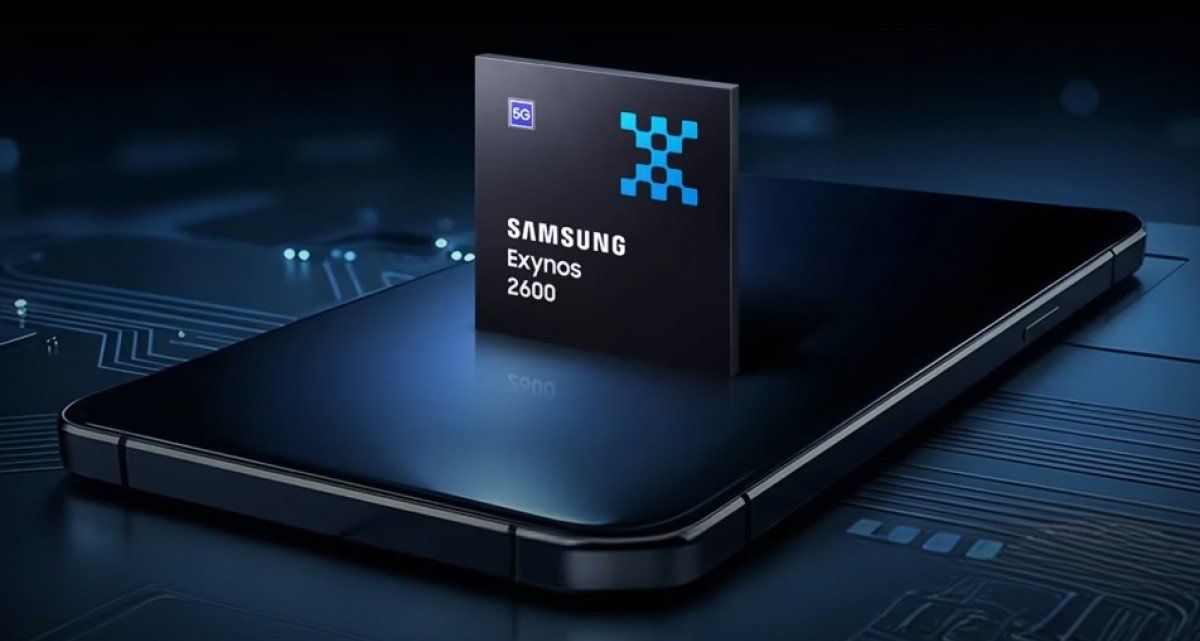
Samsung has officially unveiled the Exynos 2600, the world’s first mobile processor built on a 2nm process. The new flagship chipset signals a renewed push by Samsung to strengthen its in-house silicon roadmap. It integrates the CPU, GPU, and NPU into a single compact system-on-chip. As a result, the company expects noticeable gains in artificial intelligence tasks and high-end gaming. According to Samsung, the Exynos 2600 will debut next year inside the Galaxy S26 series smartphones. This launch is expected to play a key role in Samsung’s 2026 premium device strategy.
The Exynos 2600 succeeds the Exynos 2500 and represents a generational jump in manufacturing technology. It is produced using Samsung Foundry’s advanced 2nm Gate-All-Around process, also known as SF2. This fabrication method allows better control of current leakage and power delivery. As a result, the chip aims to deliver higher performance while consuming less energy. Samsung says this process puts it close to rivals using advanced 3nm nodes. Industry analysts note that this could help Samsung narrow the gap with competing flagship chipmakers.
At the heart of the Exynos 2600 lies a proprietary octa-core CPU design. The configuration includes one high-performance C1-Ultra core clocked up to 3.8GHz. In addition, there are three C1-Pro cores running at speeds of up to 3.25GHz. The remaining six C1-Pro cores operate at up to 2.75GHz each. This setup is designed to balance peak performance with sustained efficiency. Samsung claims this architecture improves overall CPU computing performance by up to 39 percent. At the same time, it delivers better power efficiency during everyday workloads.
The CPU also supports ARM’s Scalable Matrix Extension 2 technology. SME 2 is an instruction set extension focused on accelerating AI and machine learning tasks. It improves matrix operations used in image processing, voice recognition, and generative AI. Therefore, common on-device AI features should feel faster and more responsive. Samsung says this support enhances performance across both productivity and creative applications. This move also aligns with the growing trend of shifting AI workloads from the cloud to the device.
Graphics performance is handled by the new Samsung Xclipse 960 GPU. This deca-core GPU is based on the latest ARMv9.3 architecture. Reports suggest it is closely linked to AMD’s RDNA4 graphics technology. Compared to the previous Xclipse 950, Samsung claims up to two times higher compute performance. In addition, ray-tracing performance is said to improve by as much as 50 percent. These gains are aimed at delivering smoother visuals in demanding mobile games.
Samsung has also integrated its Exynos Neural Super Sampling technology into the GPU pipeline. ENSS uses artificial intelligence to upscale resolutions and generate additional frames. As a result, games can appear smoother without pushing the GPU to its limits. This approach helps reduce power draw and heat output during long gaming sessions. Mobile gaming continues to grow rapidly in India and other Asian markets. Therefore, these enhancements could appeal strongly to regional users.
Artificial intelligence remains a central focus of the Exynos 2600 design. The chip features an upgraded AI engine with a 32K MAC NPU. Samsung claims generative AI performance improves by 113 percent over the Exynos 2500. This boost supports faster text generation, image creation, and on-device translation features. It also enables more advanced camera processing and real-time enhancements. With AI becoming a key selling point for smartphones, Samsung is positioning this chip for future software demands.
Thermal management has long been a challenge for high-performance mobile processors. To address this, Samsung introduced a new technology called Heat Pass Block. HPB optimizes the heat transfer path within the chip package. It uses a High-Kappa Epoxy Molding Compound material to dissipate heat more efficiently. Samsung compares this approach to integrating a copper-based heat sink directly into the package. As a result, thermal resistance is reduced by up to 16 percent compared to the Exynos 2500.
This improvement should help the Exynos 2600 sustain higher performance for longer periods. Compact smartphone designs often struggle with heat buildup. Therefore, better thermal efficiency is critical for user comfort and device longevity. Samsung believes HPB will allow flagship Galaxy phones to maintain stable frame rates and AI performance. Industry observers see this as a practical response to past criticism of Exynos heat issues.
Display support on the Exynos 2600 also targets premium devices. The chip can power on-device displays with resolutions up to 4K or WQUXGA. It supports refresh rates of up to 120Hz for smoother scrolling and animations. This capability aligns with current flagship display trends. High refresh rate panels have become standard in premium smartphones. Therefore, the Exynos 2600 appears ready for next-generation Galaxy screens.
Camera capabilities are another highlight of the new processor. Samsung says the Exynos 2600 supports single camera sensors up to 320 megapixels. It also allows dual camera setups combining 64MP and 32MP sensors. For video, the chip enables single camera recording at up to 108MP resolution at 30 frames per second. In addition, it supports 8K video encoding and decoding at 30 frames per second. These specifications point toward advanced photography features in future Galaxy devices.
The imaging signal processor inside the Exynos 2600 is optimized for AI-assisted photography. This includes better noise reduction, faster autofocus, and improved HDR processing. Such features are increasingly important for social media and short-form video creators. In markets like India, camera performance remains a major buying factor. Samsung appears to be aligning the chip’s capabilities with regional consumer preferences.
Another notable change is the absence of an integrated 5G modem. The Exynos 2600 does not include built-in cellular connectivity. It also lacks integrated Bluetooth, Wi-Fi, GPS, UWB, and NFC. Instead, these functions will likely be handled by a separate connectivity chip. Samsung believes this separation reduces complexity and heat generation. It also allows greater flexibility in network component design.
This approach is not entirely new in the semiconductor industry. Some high-performance chips adopt discrete modems to improve efficiency. Analysts suggest this decision could help Samsung address thermal concerns. However, it may also impact overall power consumption depending on implementation. Samsung has not yet disclosed details about the companion connectivity chip. More information is expected closer to the Galaxy S26 launch.
Samsung also highlighted optimizations across each intellectual property block. The CPU, GPU, ISP, and NPU have been tuned for lower power consumption. This holistic optimization is designed to maximize the benefits of the 2nm process. According to Samsung, transistor density on SF2 is comparable to leading 3nm nodes from competitors. This suggests Samsung Foundry is making progress in advanced manufacturing.
From a regional perspective, the Exynos 2600 could play a major role in Samsung’s India strategy. Exynos-powered Galaxy models are common in the Indian market. Improved performance and efficiency could help strengthen consumer trust. Gaming, camera quality, and AI features are key drivers for Indian buyers. Therefore, the new chip’s focus areas appear well aligned with local demand.
Looking ahead, the Exynos 2600 represents more than a single product launch. It reflects Samsung’s ambition to compete aggressively in advanced mobile silicon. The move to 2nm places Samsung among the first to commercialize this technology. If real-world performance matches claims, the chip could reshape perceptions of Exynos processors. All eyes will now be on the Galaxy S26 series next year.

Abhijeet is a software engineer who moonlights as a tech writer. His love for gadgets, mobile innovations, and smart devices keeps him closely connected to India’s fast-growing tech scene. When he’s not coding, he’s usually testing the latest earbuds or Android updates.