
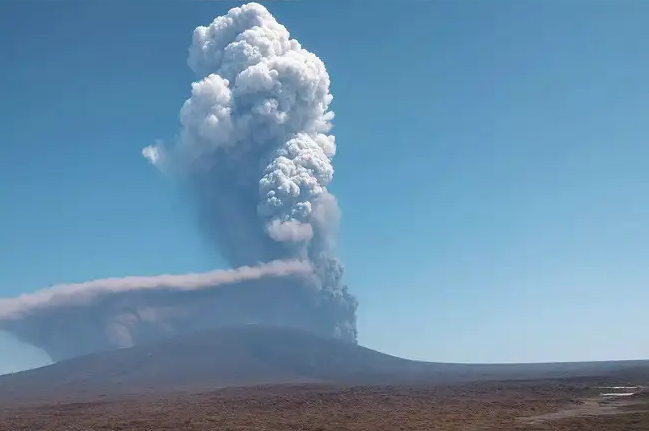
A massive volcanic ash plume from Ethiopia’s Hayli Gubbi volcano, which erupted for the first time in nearly 10,000 years, reached Delhi late Monday night, briefly alarming meteorologists, aviation authorities and travellers across India.
A Rare Eruption After Millennia
The eruption began on 23 November 2025 at 08:30 UTC, when the Toulouse Volcanic Ash Advisory Centre (VAAC) detected a towering column of ash rising to 45,000 feet (14 km). Satellite images showed a dense, sub-plinian plume drifting rapidly across the Arabian Peninsula, sweeping over Yemen and Oman before entering the Indian subcontinent.
By 20:00 UTC, the eruption’s explosive phase had largely subsided, but the ash cloud continued its long-distance journey across West Asia at nearly 130 kmph.
Ash Cloud Arrives Over North India
The plume reached Delhi around 11 pm on Monday, stretching across parts of Rajasthan, Haryana and the National Capital Region, with its trailing edge expected to brush across Gujarat. Forecast models also indicated possible overnight impacts in Punjab, western Uttar Pradesh, and areas of Himachal Pradesh.
However, according to IMD Director General Mrutyunjay Mohapatra, the ash remained more than 10 km above ground level, posing little threat to surface air quality. “The clouds are drifting towards China and will clear from northern India by 7:30 pm,” he said.
Experts echoed this assessment, noting that while minor fallout of fine ash cannot be completely ruled out, most of the material is suspended too high to affect breathing conditions. Delhi’s pollution levels, already severe before the volcanic intrusion, were unlikely to worsen due to the ash.
Unusual sunrise colours on Tuesday were considered possible due to light scattering from sulphur dioxide and fine ash particles.
Aviation Authorities Issue High Alert
The arrival of the ash cloud triggered an urgent advisory from India’s aviation regulator, the Directorate General of Civil Aviation (DGCA). Airlines were asked to avoid any ash-affected airspace, revise fuel plans, and warn flight crews about potential hazards.
The DGCA’s notice followed alerts from Toulouse VAAC, the Airports Authority of India, and an ASHTAM warning covering parts of the Muscat Flight Information Region—a key corridor for flights connecting India to Europe and the Middle East.
Pilots were instructed to report engine anomalies, cabin odours or visibility issues, all known risks when flying through ash-laden air. Dispatch teams were told to monitor NOTAMs and meteorological developments throughout the night.
Officials said that while the cloud over India was at a safe altitude for takeoffs and landings, its unpredictable movement across West Asia warranted strict caution.
Flight Disruptions Begin Across Multiple Routes
Flight schedules were among the first to feel the impact. As a precaution:
-
IndiGo’s Cochin–Dubai flight (6E1475)
-
Akasa Air’s Cochin–Jeddah service (QP550)
were both cancelled on Monday after the ash plume entered the region. Cochin International Airport confirmed the cancellations and said operations would resume once conditions stabilise.
International carriers were also affected. KLM Royal Dutch Airlines scrapped its Amsterdam–Delhi flight (KL 871) and the return Delhi–Amsterdam service (KL 872) due to safety concerns.
Indian carriers issued travel advisories for passengers:
-
SpiceJet warned of possible delays for flights crossing the Arabian Peninsula.
-
Akasa Air said it was closely tracking the eruption and would take further action based on global aviation guidelines.
With updated volcanic ash forecasts expected overnight, aviation officials said more disruptions could not be ruled out.

Prasad aka PD is an automotive enthusiast from Mumbai who splits his time between his corporate sales job and his love for motorcycles. He covers bike launches, engine tech, and the evolving EV space with genuine curiosity and excitement.